
 1447
1447The World Health Organization (WHO) Country Office has released the results of the fourth round of the Global Youth Tobacco Survey (GYTS) in Ukraine. This survey is part of the WHO’s international initiative to assess tobacco use.
In Ukraine, the GYTS was conducted in 2005, 2011, 2017, and most recently in 2023. The presented results pertain to the largest age cohort of schoolchildren aged 13-15 who participated in the study.
What the Study Showed
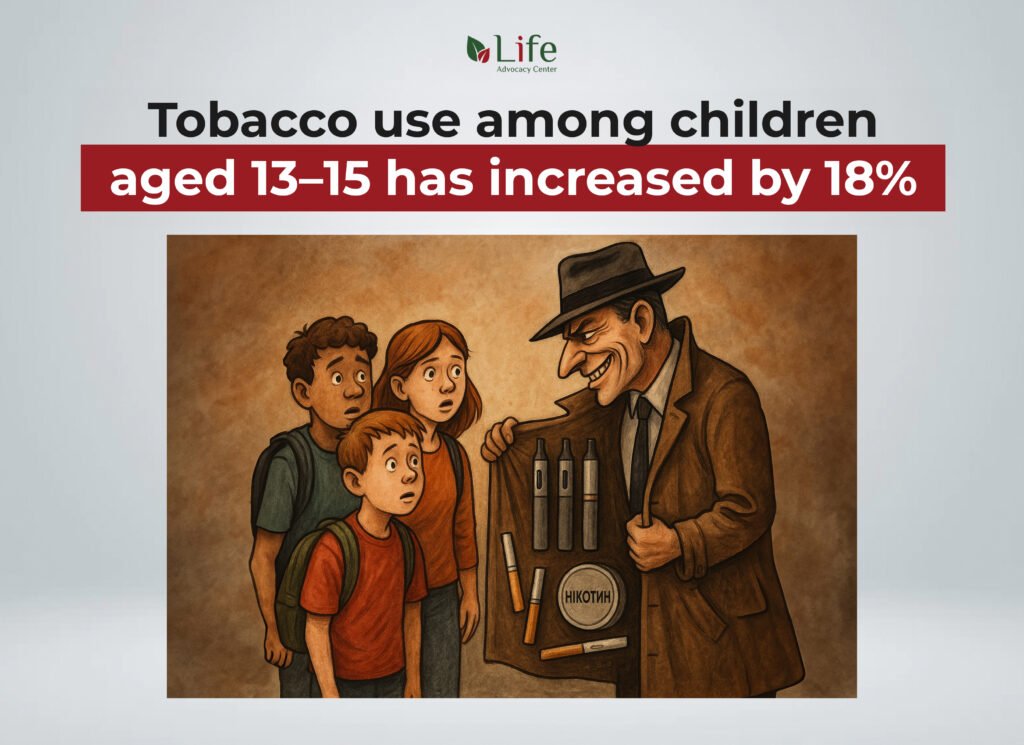
Over the past 5 years, there has been a noticeable increase in the consumption of tobacco and nicotine products among adolescents aged 13-15 in Ukraine:
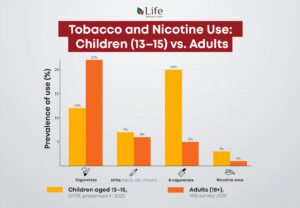
- 18% of children consume tobacco products – an 18% increase compared to 2017;
- it includes 7% who use heated tobacco products (HTPs) – in 2017, HTP use was not surveyed due to their absence on the market;
- 20% of children use electronic cigarettes – a 7% increase compared to 2017;
- 3% of children use nicotine snus (pouches) – in 2017, nicotine snus use was not surveyed due to their absence on the market.
The survey results suggest that the emergence and aggressive promotion of new tobacco and nicotine products, particularly heated tobacco products and their devices (marketed in Ukraine under brands like IQOS, glo, Ploom) and nicotine snus (pouches) (including the Velo brand in Ukraine), are leading to a significant increase in the prevalence of tobacco and nicotine use, as well as multiple product use.
Furthermore, the proportion of new tobacco and nicotine product consumption among children aged 13-15 is higher than among the adult population: 7% of children aged 13-15 use HTPs compared to 6% of adults, 20% use electronic cigarettes compared to 5% of adults (a fourfold difference!), and 3% use nicotine snus (pouches) compared to 1% of adults.
The main reason for the rise of the tobacco epidemic among children is the aggressive marketing pressure from the tobacco industry, targeting children. Specifically, 49.5% of adolescents are exposed to tobacco and nicotine product displays at points of sale. According to the American Academy of Pediatrics, children exposed to tobacco displays are 64% more likely to start smoking.
The level of accessibility to tobacco and nicotine products remains high – 47% of smokers aged 13-15 were able to purchase cigarettes independently.
At the same time, we also see a positive outcome: over the past 5 years, the number of adolescents aged 13-15 exposed to tobacco smoke in public places has decreased by 30% – from 52% to 36%. This is partly due to the adoption of Law No. 1978-IX, developed by parliamentarians from the Public Health Committee, which 100% liberated all public premises and workplaces from secondhand emissions of tobacco and nicotine products, including heated tobacco products.
The Danger of Nicotine to Children
Doctors and scientists emphasize that nicotine, regardless of the form of consumption, poses a serious threat to health, especially for children and adolescents.
Nicotine is the main cause of addiction among consumers of tobacco and nicotine products. The U.S. Surgeon General recognized as early as 2010 that nicotine causes an addiction similar in strength to cocaine or heroin. The World Health Organization (WHO) classifies nicotine dependence as a mental and behavioral disorder – “Disorders due to nicotine use” (code 6C4a in the International Classification of Diseases -11th revision).
In addition to addiction, nicotine has a number of direct toxic effects: it increases the risk of cardiovascular diseases, contributes to the development of malignant tumors, and harms the development of the brain and nervous system, especially in children and adolescents. According to EU classification (REACH), nicotine is defined as a highly toxic substance when it enters the body through the mouth, skin, or inhalation, which can be fatal in certain doses.
What to Do?
«New tobacco and nicotine products are nothing more than a marketing tool to attract new consumers, primarily children and youth. By advocating for a tobacco and nicotine-free Ukraine, we aim to add 10 years of healthy and productive life to the current and future generations of Ukrainian women and men», emphasized Dmytro Kupyra, Program Director of the Advocacy Center «Life».
Strengthening anti-tobacco legislation is the most effective method for reducing tobacco and nicotine consumption. This is proven by both global experience and Ukraine’s own experience.
After implementing comprehensive anti-tobacco measures—a ban on advertising, smoking in public places, graphic health warnings on cigarette packs, and excise tax increases—the prevalence of smoking among adult Ukrainians decreased by 20% between 2010 and 2017. Among adolescents aged 13–15, smoking rates dropped by 23% from 2011 to 2017, and by 43% compared to 2005.
However, violations of current legislation and the aggressive promotion of e-cigarettes, devices for heating tobacco and nicotine snus by the tobacco industry necessitate updating and expanding the law. Draft law №12091, registered in the Verkhovna Rada, proposes:
- Banning the display of tobacco and nicotine products at points of sale.
- Prohibiting advertising for e-cigarette and devices for heating tobacco.
- Banning flavored (fruit, candy, etc.) tobacco products.
- Introducing combined health warnings on all tobacco product packaging.
- Clarifying the powers of authorized bodies to ensure law enforcement.
To protect children from the nicotine epidemic, it’s essential to ban e-cigarettes and nicotine snus—products most often used by children. They are particularly dangerous: easily accessible, discreet to use, difficult to control, and often become the starting point for nicotine addiction.
Contact Information: Olha Masna, Media Coordinator, Advocacy Center «Life», +380 73 089 65 70, olha.masna@center-life.org