
 1325
1325According to the World Health Organisation (WHO), the tobacco epidemic is one of the biggest threats to public health, killing more than 8 million people worldwide every year. In Ukraine, 130,000 people die each year from tobacco-related diseases.
The WHO believes that the most effective measure to reduce the prevalence of tobacco use is to increase the excise tax on tobacco products. This will reduce the affordability of harmful drugs, especially for young people, and thus reduce the prevalence of smoking.
What is the current excise tax on tobacco products in Ukraine?
As of 2024, the excise tax on cigarettes, cigarillos and heated tobacco products (HTP) is UAH 2,516.54 (EUR 59) per 1,000 units. A seven-year plan to increase tobacco excise taxes is in place until 2025, which was implemented to comply with Directive 2011/64/EU (to set a specific excise tax on cigarettes at a level of at least EUR 90 per 1000 cigarettes). However, due to the devaluation of the hryvnia caused by Russia’s full-scale invasion, Ukraine will not reach the target under the current plan.
Nevertheless, the annual plan to increase the excise tax on tobacco products by 20% has proved to be effective. In 2023, revenues to the State Budget of Ukraine from excise taxes on tobacco and nicotine products totalled a record UAH 80.3 billion, up 36% compared to 2022 (UAH 59 billion) and 26.5% compared to 2021 (UAH 63.5 billion).
Given Ukraine’s international obligations under the Association Agreement with the EU and the WHO Framework Convention on Tobacco Control, the Cabinet of Ministers initiated an increase in the excise tax on tobacco products and submitted to the Verkhovna Rada draft Law 11090, to which four alternative drafts have been registered.
What proposals to increase the excise tax on tobacco are being considered by the Verkhovna Rada?
Five draft laws on increasing the excise tax were submitted to the Verkhovna Rada. The first draft law No. 11090, initiated by the Ministry of Finance of Ukraine, proposes to switch to measuring the excise tax rate in euros, which is a rational decision, as it will avoid the risks of the hryvnia devaluation. At the same time, the proposal to grant a tax preference to heating tobacco products (HTPs) compared to cigarettes and cigarillos is unacceptable. The government proposes to reach an excise rate of 90 euros per 1000 units for cigarettes and cigarillos by 2028 (which is unreasonably long), while for HTPs it is only 72 euros per 1000 units. Thus, the tax preference for heating cigarettes will be 20%.
This position of the Cabinet of Ministers of Ukraine reflects the interests of the tobacco company Philip Morris International, which controls 80% of the market for heating cigarettes in Ukraine (used with IQOS devices) and is recognised by the NACP as an international sponsor of the war against Ukraine. As a reminder, PMI is the largest international taxpayer in Russia. In 2022, the company paid $4.756 billion to the Russian budget.
Draft laws No. 11090-1 and No. 11090-2 also propose a delayed plan to increase the excise rate to EUR 90/1000 units by 2028 and 2029, respectively, and to maintain the tax preference for HTPs. Such proposals are contrary to the interests of health protection and delay the fulfilment of international obligations.
Draft Law 11090-4 proposes to achieve the requirements of Directive 2011/64/EU by 2026 and to maintain the harmonised tax on heating tobacco products. Draft Laws No. 11090-4 and No. 11090-1 also provide for an increase in the ad valorem excise tax rate.
However, today in most EU member states, the minimum tax liability on cigarettes is already well above EUR 90. According to the European Smoke Free Partnership coalition, the average excise tax on cigarettes in the European Union is €177 per 1,000 units. In view of this, the European Commission plans to revise Directive 2011/64/EU and increase the minimum excise tax on tobacco products to at least €180 per 1000 units.
The most beneficial for Ukraine, both in terms of protecting the health of young people and filling the state budget and fulfilling international obligations, is draft Law 11090-3, which proposes a plan for a harmonised increase in excise duty on cigarettes, cigarillos and HTPs to €120/1000 units by 2028. According to the calculations of experts of the NGO ‘Life’, the implementation of such a plan will bring EUR 13.14 billion (UAH 558 billion) to the state budget in 2025-2028. At the same time, the government’s draft law No. 11090 provides for revenues of only €11.78 billion (UAH 500 billion).
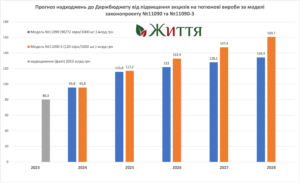
Thus, the revenues to the state budget if the excise tax increase model envisaged by the draft law No. 11090-3 is applied will be EUR 1.36 billion (UAH 58 billion at the current euro exchange rate) higher by 2028 than the revenues envisaged by the government’s draft law No. 11090.
At the same time, the tax preference for HTPs proposed by the government (even under its model of 90 euros per 1000 cigarettes and cigarillos, but 72 euros per 1000 HTPs) will increase the prevalence of tobacco use among Ukrainian youth and lead to an annual budget shortfall of about UAH 5 billion from this category alone.
By definition, HTPs are tobacco products that directly harm consumers’ health – and therefore the WHO clearly emphasises the need to apply tax measures and marketing restrictions on a par with traditional cigarettes. The experience of Ukraine, which in 2021 harmonised excise taxes on HTPs, cigarettes and cigarillos to the same level, has demonstrated impressive efficiency: state budget revenues from excise taxes on HTPs increased 6-fold in just 1 year (from UAH 1.7 billion in 2020 to UAH 10.2 billion in 2021). This decision has been recognised as the best international practice, as stated in a letter from WHO Director-General Tedros Ghebreyesus to President of Ukraine Volodymyr Zelenskyy.
Despite the pressure from the tobacco industry and the promotion of manipulative narratives about ‘less harm’, the government and parliament must first and foremost protect the interests of civil society and maintain revenues for Ukraine’s military budget.
An increase in excise taxes on tobacco products to 120 euros per 1000 pieces by 2028 will allow Ukraine to:
– fulfill European integration obligations under Directive 2011/64/EU and prepare the ground for further increases prepared by the European Commission;
– significantly fill the state budget and obtain additional resources to counter Russian aggression;
– reduce the availability of tobacco products, especially among young people;
– reduce the pressure on the health care system from tobacco-related diseases.
In addition, the conditions will be created to combat the movement of illegal tobacco products from Ukraine to the EU market. The increase in excise duty will help to equalise the price gap, making the illegal sale of tobacco products from Ukraine to the EU unprofitable.
Contact person: Olha Masna, media coordinator at NGO Life, 073 089 65 70, olha.masna@center-life.org