
 217
217On 10 June 2026, Italy’s Competition and Market Authority (Autorità Garante della Concorrenza e del Mercato, AGCM — hereinafter, the Antitrust Authority) fined the Italian subsidiary of Philip Morris International (Philip Morris Italia S.r.l.) €7 million for unfair commercial practices and misleading consumers. The reason was the company’s systematic use of phrases such as “smoke-free,” “smoke-free products,” and “building/designing/accelerating a smoke-free future” to promote tobacco and nicotine products — specifically heated tobacco devices, e-cigarettes, and nicotine pouches.
This case is highly relevant for Ukraine as well, since Ukrainians encounter identical misleading advertising every day.
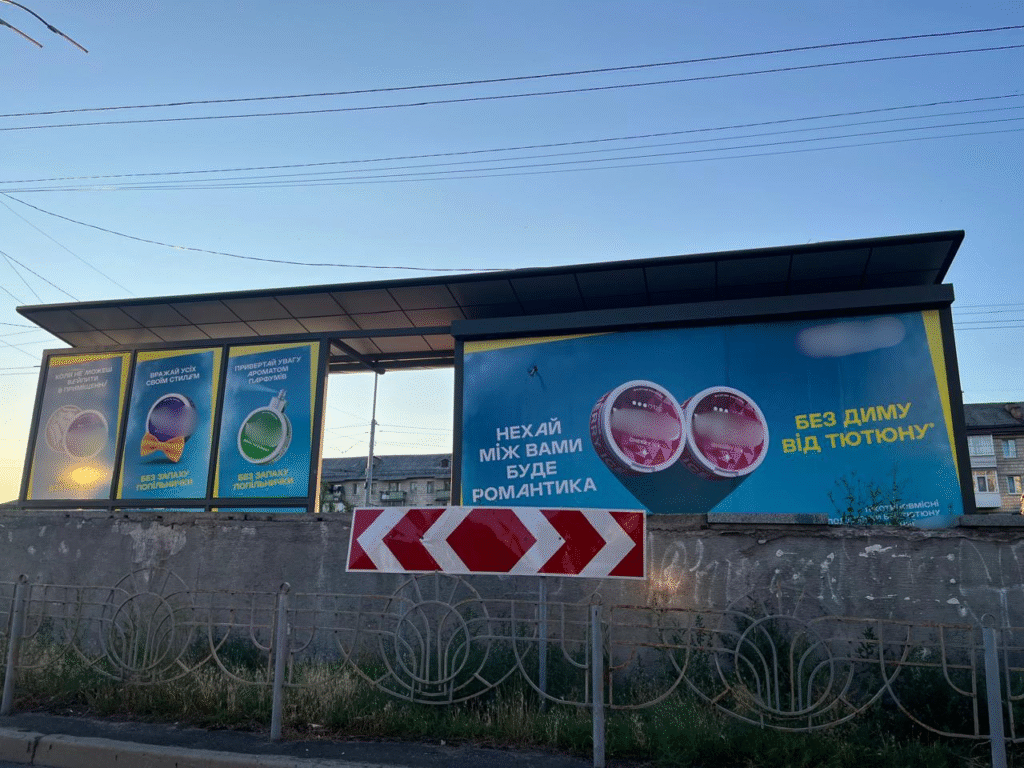
Nicotine pouch advertisement at a public transport stop. Kyiv, 2026. Photo: NGO “Life”
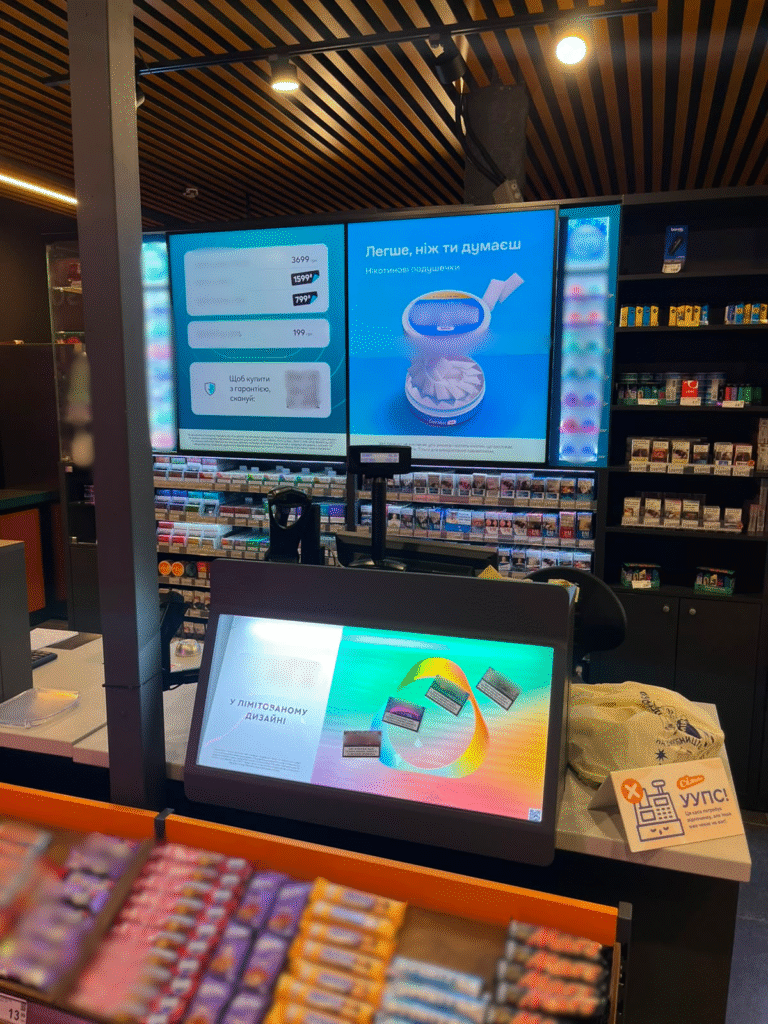
Advertisement for nicotine pouches and heated tobacco products in the “Silpo” supermarket chain. Photo: NGO “Life”
What the Italian Regulator Established
The investigation began on 7 October 2025 following a complaint from Italy’s Ministry of Health, which flagged Philip Morris Italia’s advertising campaign under the slogan “Together we are building a smoke-free future in Italy”. The review covered three product categories that the tobacco company markets under the shared slogan “smoke-free”: heated tobacco devices, e-cigarettes, and nicotine pouches.
Based on its review, Italy’s Antitrust Authority found that the systematic use of the term “smoke-free,” combined with promises of a “smoke-free future,” creates a false impression among consumers — including minors — that these products are safer or less harmful than conventional cigarettes. As a result, such claims misled consumers and significantly restricted their freedom of choice, pushing them toward purchases they might not otherwise have made.
The Antitrust Authority specifically emphasized that the misleading nature of these claims carries particular weight precisely because it concerns products capable of endangering consumers’ health — first and foremost, children’s health. Evidence gathered during the inspections included facts showing the company deliberately monitored an audience of minors as young as 11 years old, to whom the sale of tobacco and nicotine is prohibited by law.
Moreover, even the scientific studies the company itself submitted to the Authority in its own defense showed the opposite: there is currently no scientific or medical basis for concluding that new tobacco and nicotine products are less harmful to health.
Based on these findings, the Antitrust Authority classified Philip Morris Italia’s marketing campaign as an unfair commercial practice and banned its distribution or continuation.
The World Health Organization’s Position
In this case, the World Health Organization confirmed that heated tobacco products (HTPs) contain nicotine and toxic substances, often at concentrations equal to or even higher than those in conventional cigarettes. According to WHO data, there is no evidence that heated tobacco products are less harmful. On the contrary, they release unique and potentially carcinogenic chemicals whose health effects are still being studied but are already raising concern.
WHO representatives explain that, by scientific definition, smoke is a type of aerosol — a system of fine particles suspended in gas. Although heated tobacco systems do not involve classic combustion, which is usually associated with smoke, the substances in the liquids of these devices are converted into other compounds through heating via a process of pyrolysis. The resulting vapor, under this definition, is smoke — meaning that any vapor emitted by such devices is tobacco smoke.
Regarding e-cigarettes, WHO stresses that these are hazardous products containing carcinogenic substances that can cause poisoning, injury, and cardiovascular disorders. In addition, nicotine in e-cigarettes harms brain development in children, adolescents, and fetuses, while dual/combined use with other tobacco and nicotine products increases nicotine intake, deepens addiction, and creates additional health risks.
Regarding nicotine pouches, WHO noted that they can raise heart rate and blood pressure. There is also concern about the chemical composition of these products, as they may contain synthetic nicotine with unknown metabolic effects, or residues of carcinogenic nitrosamines derived from tobacco.
Why This Matters for Ukraine
The precedent set by the Italian Antitrust Authority’s decision is extremely relevant for Ukraine, where tobacco companies employ identical marketing strategies to aggressively promote new tobacco and nicotine products. While European regulators are already holding tobacco companies accountable for unfair advertising, Ukraine’s regulatory space remains vulnerable due to the lack of adequate legislation.
Nevertheless, in 2024 the Antimonopoly Committee of Ukraine found that the actions of “Philip Morris Sales and Distribution” LLC violated legislation on protection against unfair competition. The tobacco company was ordered to stop disseminating information that misled consumers about IQOS devices and the tobacco products used with them.
To address these threats, Ukraine urgently needs to adopt systemic legislative solutions. An important step toward harmonizing Ukrainian legislation with EU norms is the adoption by the Verkhovna Rada of Ukraine of European-integration draft law No. 12091. Its passage would allow Ukraine to fulfill its obligations to ban flavored heated tobacco products and would finally eliminate any advertising preferences for heated tobacco devices, bringing them fully in line with the requirements applicable to tobacco products.
A separate threat is currently posed by nicotine pouches, which — due to the absence of proper legal regulation — are freely sold and aggressively promoted among children. With their high nicotine concentration, they quickly create dependence. According to WHO data, the prevalence of nicotine pouch use among Ukrainian children aged 13–15 has already reached 3%, ten times higher than the corresponding rate among adults (0.3%). The Verkhovna Rada of Ukraine is currently considering draft law No. 14110, which proposes a full ban on nicotine pouches, and draft law No. 14110-d, which proposes regulating their circulation on par with tobacco products. At the same time, Ukraine’s Ministry of Health and WHO insist that a complete ban is the most effective solution to protect children. Belgium, the Netherlands, Germany, France, and Moldova have already adopted such bans.
Another important tool for protecting Ukrainians would be a ban on e-cigarettes and e-liquids, as proposed by draft law No. 13548-4. This would help prevent children from being drawn into nicotine addiction, given that 20% of children are already users of such products.
Together, these legislative initiatives form a comprehensive regulatory response to a challenge that the Italian experience has only confirmed: consumers — and children above all — remain defenseless against the misleading marketing strategies of tobacco companies. This is why it is time to act and stop the threats posed by tobacco and nicotine use, which claim the lives of nearly 100,000 Ukrainians every year.
Author: Yuliia Manuilova, legal consultant, NGO “Life”