
 194
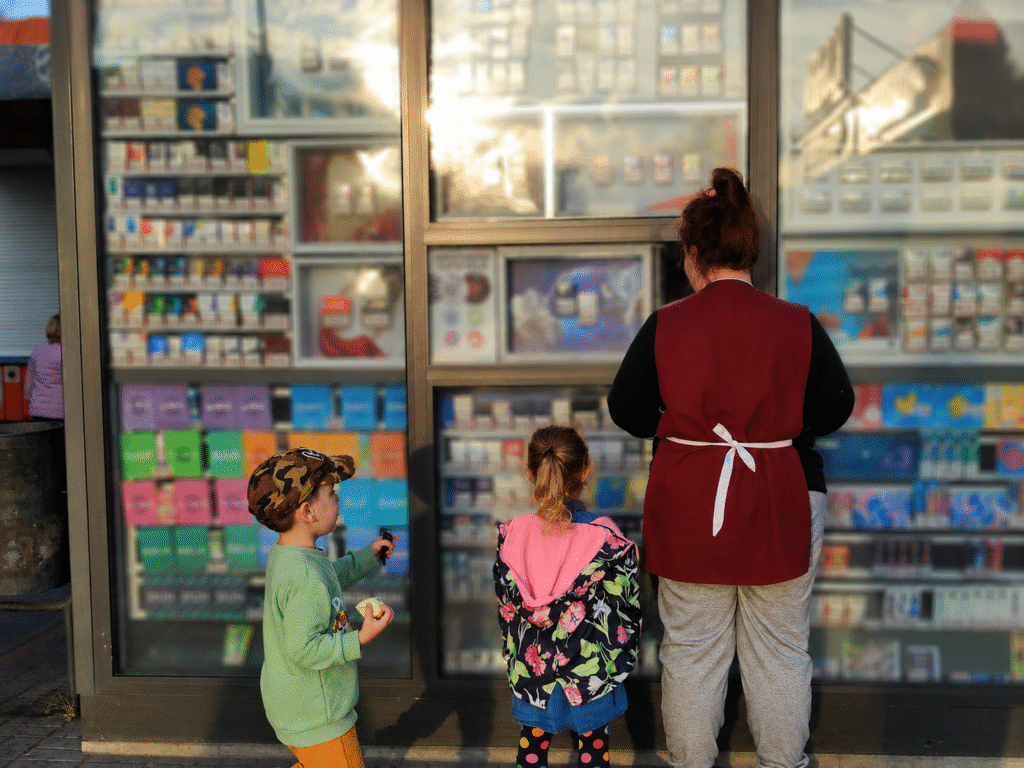
194Children who see tobacco products in retail environments face a 64% higher risk of developing a nicotine addiction. However, this is precisely what the tobacco industry aims for — children represent potential long-term consumers, and consequently, long-term profits.
It is virtually impossible to imagine visiting a supermarket, store, kiosk, or gas station without encountering a striking wall of cigarettes. Brightly lit, branded tobacco displays are meticulously designed to capture the attention of every shopper.
Following statutory bans on tobacco advertising and sales promotion, the industry swiftly realigned its strategies, transforming point-of-sale (POS) locations into the primary stage for aggressive marketing. Today, traditional advertising banners have been largely superseded by so-called “Power Walls” — vivid display cabinets, branded checkout zones showcasing tobacco products, and digital promotional screens.
While legislation prohibits any tobacco advertising, color inserts, backlighting, or visual focal points at points of sale, the tobacco industry routinely deploys these structures in defiance of the law to recruit new consumers and retain those already suffering from nicotine addiction.
How Tobacco and Nicotine Outlets Shape the Daily Environment in Ukraine
According to the State Tax Service, as of June 2026, Ukraine has more than 65 000 active retail licenses for tobacco products and e-cigarette liquids:
- 64,897 retail licenses for tobacco products.
- 560 retail licenses for liquids used in electronic cigarettes.
Data from the Institute of Demography and Quality of Life Research of the National Academy of Sciences of Ukraine indicates that as of July 2026, the permanent population in government-controlled territories of Ukraine stands at approximately 29 million people. Given this population size, 65 000 retail outlets translate to a ratio of 2.24 tobacco and nicotine sales points per 1 000 residents, including infants and children.
Compared to 2022, the total number of licenses has remained largely unchanged, yet the density of retail outlets per 1 000 people has increased by nearly 10%.
If we consider estimates by the Ministry of Social Policy — which put the current population in government-controlled areas at 22–25 million — the ratio rises further to between 2.6 and 3 retail outlets per 1,000 people.
With such an excessive concentration of retail venues, the tobacco industry guarantees its presence along virtually every path taken by children and teenagers.
The highest concentration of licenses is found in the country’s largest regions: Lviv (5,865), Dnipropetrovsk (5,882), Kyiv (5,510), Odesa (4,404), and Kharkiv (3,659) Oblasts, alongside the capital, Kyiv (4,453).
A similar situation surrounds the availability and promotion of alcohol. Currently, approximately 87 000 alcohol retail licenses are active nationwide, amounting to roughly 3 outlets per 1 000 residents. The World Health Organization recommends regulating the quantity, density, and location of alcohol retail outlets as a key measure to curb consumption.
What Research Shows
International scientific evidence confirms that the high density of retail outlets — combined with eye-level, prominent product displays — serves not merely as a vector of physical availability, but as a direct instrument of consumer marketing pressure. It is crucial to understand that “consumers” include anyone presented with an offer to purchase tobacco and nicotine products, regardless of whether a transaction takes place. Higher outlet density directly correlates with rising smoking rates among both adults and children, reduces the likelihood of successfully quitting nicotine addiction, and triggers relapses among former smokers.
Children remain the primary target of the tobacco industry’s promotional efforts. According to the American Academy of Pediatrics, children exposed to POS cigarette displays are 64% more likely to start smoking compared to those living in communities where retail tobacco displays are banned.
Furthermore, retail displays create significant hurdles for adults attempting to break free from nicotine addiction: 38% of adult smokers trying to quit report that seeing tobacco products on display in stores triggers an impulsive urge to consume tobacco.
The industry relies on aggressive display tactics to maximize revenues; studies demonstrate that point-of-sale displays increase overall tobacco sales volumes by 12% to 28%.
The Netherlands offers a compelling model for addressing this issue through systematic reductions in retail outlets. On January 1, 2024, the country enacted a complete ban on tobacco sales in supermarkets, eliminating roughly 40% of all tobacco outlets at once. That single regulatory measure reduced the national smoker population by 23 000 individuals (1% of total smokers) in just one year. The Dutch government’s roadmap for 2030–2032 envisions removing tobacco entirely from gas stations and convenience stores, restricting sales exclusively to specialized tobacco shops.
Hungary presents another persuasive example: following comprehensive reform, the density of tobacco outlets was reduced to 0.6 per 1 000 residents. Similar approaches are evident elsewhere: Finland maintains just 1 retail outlet per 1 000 residents, while Australia operates at 1.2 per 1 000.
Solutions for Ukraine
Aggressive point-of-sale tobacco and nicotine advertising remains a primary driver drawing children and young people into addiction. WHO data reveals that every second child in Ukraine is exposed to tobacco marketing directly at retail outlets. For young adults aged 18–29, retail product placement represents the single largest advertising channel. Meanwhile, 81% of Ukrainian citizens support a total ban on retail tobacco and nicotine displays.
Against this backdrop, implementing Article 13 of the WHO Framework Convention on Tobacco Control (FCTC) is of critical importance for Ukraine. Its guidelines mandate a total ban on any display or visibility of tobacco products at points of sale, defining such displays as advertising and promotion. This standard has proven effective and is already enforced in 59 countries.
To resolve this issue, Ukraine has drafted European-integration Bill No. 12091, which includes a comprehensive prohibition of retail tobacco and nicotine displays. Banning POS displays will clean city streets of intrusive tobacco and nicotine advertising along daily routes from home to school. It is a proven mechanism for eliminating aggressive industry marketing, reducing the exposure of children to nicotine products, and safeguarding individuals in recovery from potential relapse.
Each year, approximately 100 000 people in Ukraine die prematurely from tobacco-related diseases, costing the country an estimated 3.2% of its GDP. Amid an ongoing demographic crisis, the effective implementation of tobacco control measures will ease the burden on the healthcare system, reduce premature mortality, and contribute positively to national socio-economic recovery.
Dmytro Kupyra, Program Director of NGO “Life” for Ekonomichna Pravda
Co-author: Yuliia Manuilova, Legal Consultant at the NGO “Life”